
I have long suspected, but recently had it confirmed to me, that soon 'Onlive', or a similar technology is going to take over the world.
For those who are unfamiliar with Onlive, it is a gaming service that changes the way that games are played and interacted with. The user has an Onlive console/modem plugged into their TV, and a control pad connected to that, not unlike a normal console. However rather than putting a disk into this console, it connects via the internet to the Onlive servers, where the games are hosted, and you play them, literally, online. The console sends your controller inputs to the Onlive servers, where the game is updated, and then receives back the pictures to put on the TV. All that the box under your TV does is send the controls, and receive back raw images to display, no actual processing takes place at all. This means that you can instantly play any game on the Onlive servers, and never have to upgrade your hardware. New games can be played as soon as they are available, there is no waiting for DVDs in the post or waiting for game files to download off Steam. Updates and patches are taken care of immediately, and you never have to worry about having to run that game at anything other than full detail, because Onlive take care of all the processing. Also available with the service is a PC app that allows you to do the same thing on an internet enabled PC, turning any computer at all into a top-spec gaming rig.
The moment that I decided that this method of game delivery would take over the world was when I realised that if sufficient bandwidth is available, you can play the same game on a top-spec PC or 50" TV as you can on an iPad, and using the same save games. So if you are addicted to Skyrim, but had to catch the bus to work, you can log off your TV console, log onto your iPad version of Onlive, and carry on the exact same game from exactly where you left off, with the exact same graphics.
This is a paradigm shifting tech, and the implications are very wide ranging. People are already moving away from the traditional mode of purchasing games, with direct-download services like Steam and XBLA becoming more and more popular. Onlive completely removes not only the need to buy new game disks, but also the need to buy new consoles, and if people are happy with not physically owning game disks anymore, it's only one step removed to not having any copy of the game at all, just the rights to play it. The days of console wars will be gone, all games will be playable on the same system, the only thing you will need to buy is a new controller if a new one is released. Games will no longer be limited by console hardware, opening the floodgates for larger and faster leaps in graphics technology.
After the games side of the business is strong enough, there is nothing to suggest they won't start offering other services as well. TV, films and music are all already available to stream online, so it's not a big jump of the imagination to see the Onlive tech being adapted for that as well.
As a sales platform as well it is incredibly strong. Game demos are taken care of by allowing someone to play a game and then cutting them off after a certain time or when they've completed *this* much. Then purchasing the game after that is as easy as telling Onlive to add it to your library of available games, either as a rental, or a permanent purchase. They also run a monthly payment service that gives you unlimited access to a library of games. Piracy is completely removed, as the game can never exist anywhere but on the Onlive servers.
The drawback that most people will point out is the obvious time delay that will take place between sending instructions across the internet and receiving back the onscreen-images. This is clearly a problem, but as the internet gets faster, the delay will evaporate, and reports say that it is negligible anyway. Also, to counteract this delay, there is the fact that multiplayer lag is removed totally, as all the games will be hosted at the same server location. Another sticking point is that if your internet goes down, all your games are completely unplayable. This is a more fundamental problem, but as internet connectivity is fast becoming omnipresent and stable, and it's an issue that other services suffer from as well, it is something else that fails to be a deal-breaker. Motion-control gaming could be something that the service struggles with at first, as particular hardware is needed to play games with this control style, but there is nothing to say that custom peripherals will become available.
I really see this technology taking off hugely as it becomes better recognised and the internet gets faster. The world is already moving towards cloud computing, with offsite processing and file storage featuring more and more in our day to day lives. It will be a very interesting few years as Onlive picks up speed and tries to find it's place in the gaming ecosystem. If games production companies see the potential and embrace it (and there's no reason not to) we could well see a huge change in the way we consume games and other entertainment very soon.
Sunday, November 20, 2011

Tuesday, September 13, 2011
Drumroll Please...
The news that has been a year in the making has just broken: I got a job.
After searching high and low for someone to give me a chance, I have been lucky enough to get a position as a 'Lighting and Rendering artist' at Red Star 3D. I first completed 2 fortnight long sessions of work experience with them, and have now been asked to stay on for a 2-month trial before becoming a permanent employee.
While it's not a job modelling for a games company as I had expected, I'm incredibly happy to be working there. The company is only 10 people, working very closely together to produce great 10 minute 4D films. 4D is wearing 3D glasses and having the cinema chairs shake, water squirted in your face etc. The type of thing that's typically seen in theme parks and leisure attractions. Joining such a close-knit team should be great fun, as the input everyone in the office gets into the films is huge; creatively and practically.
I personally will be getting fully animated scenes and setting up the lighting for them. This may sound dreary at first, but really is one of the most crucial parts of the whole process. Lighting can change a scene from day to night, rain to shine, and funny to downright creepy. In fact during my 2nd work experience there I was re-lighting existing scenes from the latest project, and it's amazing how much of a change you can make to the feel of the film just by taking a different approach to lighting.
I'll also be taking care of the rendering and compositing of my scenes, which means setting up the computers to change them from mathematical scenes inside their hard-drives, to full motion video images, another job that has a lot of responsibility.
The oddest thing about the whole situation is I've ended up back in Sheffield, over a year since leaving and expecting to move somewhere completely different. It's great to see everyone again, and to visit old hangouts, even if it does feel weird to be back. The office building we're located in is called 'Electric Works', and is pretty fantastic. There is a helter-skelter from the top floor (where we're based) down to the lobby, so rather than taking the lifts we can do that instead, makes for a great end of the day.
Hopefully after the 2 month trial is done, I'll be asked to stay on. It's hard to get settled in a place when there's that uncertainty over you, but I'll try to enjoy my time here anyway and work hard to impress and make myself invaluable.
After searching high and low for someone to give me a chance, I have been lucky enough to get a position as a 'Lighting and Rendering artist' at Red Star 3D. I first completed 2 fortnight long sessions of work experience with them, and have now been asked to stay on for a 2-month trial before becoming a permanent employee.
While it's not a job modelling for a games company as I had expected, I'm incredibly happy to be working there. The company is only 10 people, working very closely together to produce great 10 minute 4D films. 4D is wearing 3D glasses and having the cinema chairs shake, water squirted in your face etc. The type of thing that's typically seen in theme parks and leisure attractions. Joining such a close-knit team should be great fun, as the input everyone in the office gets into the films is huge; creatively and practically.
I personally will be getting fully animated scenes and setting up the lighting for them. This may sound dreary at first, but really is one of the most crucial parts of the whole process. Lighting can change a scene from day to night, rain to shine, and funny to downright creepy. In fact during my 2nd work experience there I was re-lighting existing scenes from the latest project, and it's amazing how much of a change you can make to the feel of the film just by taking a different approach to lighting.
I'll also be taking care of the rendering and compositing of my scenes, which means setting up the computers to change them from mathematical scenes inside their hard-drives, to full motion video images, another job that has a lot of responsibility.
The oddest thing about the whole situation is I've ended up back in Sheffield, over a year since leaving and expecting to move somewhere completely different. It's great to see everyone again, and to visit old hangouts, even if it does feel weird to be back. The office building we're located in is called 'Electric Works', and is pretty fantastic. There is a helter-skelter from the top floor (where we're based) down to the lobby, so rather than taking the lifts we can do that instead, makes for a great end of the day.
Hopefully after the 2 month trial is done, I'll be asked to stay on. It's hard to get settled in a place when there's that uncertainty over you, but I'll try to enjoy my time here anyway and work hard to impress and make myself invaluable.
Tuesday, July 19, 2011
Character Bio
Recently, a bunch of my friends and I began a Dungeons and Dragons campaign, and as such I had to create a character. I'm the type of person who takes this sort of thing seriously, so decided to write a backstory and some special rules for my hero, as I figure it's always more fun to play as someone with a bit of personality.
Our DM manages a Games-Workshop, so it made sense that we set our game in the 'Warhammer' universe. After a bit of thought I came up with a bio I liked and thought would be fun to play:
It's not very often I get to do creative writing like this, and I really enjoyed it. I plan to possibly write up the gaming sessions we have in the same style, so maybe one day I'll have a substantial body of work built around this character and his party.
Our DM manages a Games-Workshop, so it made sense that we set our game in the 'Warhammer' universe. After a bit of thought I came up with a bio I liked and thought would be fun to play:
Name: Tzega DreamcasterType: Eledrin Wizard (Controller)Age: 17Birth Name: Dogshite Shadowmelt
Dogshite was the 14th child of the Eledrin couple: Esmerelda and Lucius Shadowmelt. His parents were drunkards and had been exiled from the Feywild after being caught stealing Moonshine from the shamans stores. Travelling across the sea they arrived at Marienburg where they each took jobs as barmen, remained alcoholics, and began a family. When their 14th child was born they were both too drunk to think of a proper name, and in their drunken haze christened him 'Dogshite', as it was “hilarious at the time”. His first meal from his mothers teat was so alcoholic that he became addicted then and there, and was constantly drunk up until his 15th birthday.On the 15th anniversary of his birth Dogshite went to his parent's tavern, where he would hide under tables and sneak drinks from passed out customers. As usual he set up camp in a shadow near the bar, and began to quietly quaff anything that was left unattended for more than a few seconds. Late that night, after enough alcohol to kill a large goblin, he was caught trying to steal a drink from a customer who wasn't as drunk as he had thought, and was being dragged out of the tavern by the scruff of his neck when he scrambled free and turned on his captor. Not really thinking, he punched his assailant as hard as he could, and to his great surprise the man turned into a trumpet. Seeing this the other drinkers in the bar accosted him, and held him down until the City Guard arrived and took him away to spend a few days in the cells while they worked out what to charge him with.He awoke early the next afternoon, still drunk as usual, and reached out for his 'jump-starter' triple shot of Dwarven whisky. However due to being incarcerated, he was unable to get his waking hit, and began the slow and incredibly painful process of sobering up for the first time ever.Eighteen hours later, the guards returned to his cell, and found, in place of the dribbling, speech slurring vagabond they had picked up the day before, a sober and fiercely intelligent young Eledrin, playfully sending showers of sparks from his fingertips. Their prisoner then eloquently explained to them that if he had stolen from and attacked someone then surely there would be a victim to present their case, and the lack of this elementary piece of evidence rendered him innocent. Upon being released, and pausing only briefly to collect his trumpet from the jailer, he made his way back to the bar, where he explained to his stunned parents that he was in fact a genius and had considerable magic ability, but had always been too sloshed to realise. Bundling up all his worldly belongings (a set of teletubby shotglasses, a tankard shaped like a teddy bear and 3 bronze pieces saved from the time he had accidentally walked somebody's dog for them) he left home, choosing then to adopt a new name (inspired by something he had heard a Japanese tourist saying): “Tzega Dreamcaster”.Having left his home, he became apprenticed to a travelling Wizard, following him from city to city, learning as they went. Tzega found it hard to kick the bottle, often turning up to lessons drunk, but as the time passed he mastered the art of drunken magic, finding that he could perform spells equally competently whether intoxicated or not. However his decision making was certainly still affected, and on more than one occasion he and his master had to leave town in haste after Tzega drunkenly blared on his trumpet and then transformed the interfering city guards into mice.After 2 years of tutoring, with all the wisdom of a 17 year old, Tzega declared himself ready to face the world alone and left his master in search of fame and fortune. He returned to his home city and declared himself available for hire, and this is where we meet him now...
Special Rules
Alcoholic: Due to his past, Tzega finds it very difficult to be around alcohol or drinkers. When in a tavern or around alcohol, every 10 waking minutes he must take a will-power roll to see if he has a drink. For every drink he has had in the previous 4 hours he takes a -1 modifier on this roll.
Hardened Drinker: Having grown up with alcohol in his veins Tzega is unaffected by the normal rules of intoxication.
Drunk and Disorderly:
As he becomes more and more drunk Tzega's alignment moves from True Neutral to Chaotic Neutral. 0 drinks = 100% TN, 6 drinks =100% CN.
As he becomes intoxicated, decisions Tzega makes become increasingly random. Dice rolls decide his behaviour, with modifiers added for each drink consumed.
Brass Knuckles: If Tzega ever kills a creature with a melee attack, roll a D6. On a 6 the creature transforms into a random brass instrument. For every drink Tzega has had in the last 4 hours, the number needed for transformation falls by 1 to a minimum of 2.
It's not very often I get to do creative writing like this, and I really enjoyed it. I plan to possibly write up the gaming sessions we have in the same style, so maybe one day I'll have a substantial body of work built around this character and his party.
Wednesday, May 18, 2011
Importance of moddable games
I recently bought StarCraft 2, a game synonymous with online dueling, and a game built almost purely around the attraction of it's deep strategy mixed with fast gameplay. However, since getting it I've probably spent less than half my time ingame actually playing StarCraft 2 as it was designed by Blizzard, the rest of my time has been taken up with player created custom games.
One of the attractions of a game like SC2 is the incredible wealth of custom maps and game modes that get churned out by enthusiastic amateurs. A lot of them are buggy, uninspired or just plain boring, but there are a lot of exceedingly fun ones as well.
The best example of a Battle.net based custom game exploding is the Wacraft 3 custom game: 'Defence of the Ancients' or DOTA as it's now known. DOTA basically invented a new genre of strategy game, and in some respects has become more popular than the game it was created inside. It is featured in international tournaments with thousands of dollars of prize money, the designer now works at Valve developing a sequel, and there are 3 fully released clones of it available for PC and consoles( DemiGod, HON and LOL), and .
Of course, as far as mods go, DOTA is one of the largest, but the most famous game modification (or mod) of all has to be Counter-Strike. A mod for the original Half-Life, developed by two amateurs, at it's peak it had three times as many players as it's nearest (studio created) competitor. Professional teams sprung up, earning their livings from tournament winnings and sponsorships, the most popular players began to release their own lines of mousemats and headphones, and matches were televised across the world. CS was bought by Valve, the developers of HalfLife, and republished and updated with their new 'Source' engine. However at the time of writing, the original CS is still the most played game on Steam, with more than even the record breaking Call of Duty: Black Ops:

Counter-Strike and DOTA are not the only games to have lead to commercial releases. Valve also released 'Team Fortress 2' a sequel to the incredibly popular Quake mod 'Team-Fortress' (which already has 2 other fan-made sequels), user made mods were shipped with the Civilization IV expansion pack, and Unreal 3 Mod "The Ball" was released on Steam as well.
Custom games and an active modding community can be one of the most important things I look for in a game these days. I know first hand that using mods can improve the life of a game, and also changes the prospects of buying a sequel. I asked a friend of mine if he wanted to play some 'Left for Dead 2', fully expecting him to have this classic game, but he replied that he had never bought it, he didn't really like the original due to it's short storyline and lack of replay value. "Lack of replay value? Did you not see how many custom maps, scenarios and entire campaigns were available, FOR FREE, all over the internet?" Granted the original game could be played through in probably under 10 hours, but with five minutes of searching you could add easily 10 times that amount of gameplay time. This was one of the reasons I enjoyed the first game so much, and was definitely one of my biggest considerations when deciding to purchase the sequel.
Sites such as moddb.com have risen out of the need for aggregators of this custom content, with rating systems to ensure that the best mods get the most recognition and downloads that they deserve, and now entire games are created with the explicit aim of allowing the player to create their own content. The most well known example of this is 'Little Big Planet' and it's sequel. These are essentially game creation toolboxes, with simple controls and a very powerful interface that let players make just about anything they want.
Mods are increasingly affecting the game industry, with entire amateur teams being hired by studios, mods being shipped with official expansion packs, and new commercial games being based on popular mods more and more often. This wide-stream acceptance of game modding can only be good for the industry as companies now have a proving ground for new designers and developers, where the best and brightest can be clearly seen. The amateur creators also profit from the experience they gain and from the satisfaction of playing a critical role in a games development long before they ever join a full studio. And most importantly, gamers in general benefit from the wealth of extra content that becomes available for their favorite games. I hope that more and more companies encourage and allow people to add to their games, as it's one of the best things about the industry at the moment.
One of the attractions of a game like SC2 is the incredible wealth of custom maps and game modes that get churned out by enthusiastic amateurs. A lot of them are buggy, uninspired or just plain boring, but there are a lot of exceedingly fun ones as well.
The best example of a Battle.net based custom game exploding is the Wacraft 3 custom game: 'Defence of the Ancients' or DOTA as it's now known. DOTA basically invented a new genre of strategy game, and in some respects has become more popular than the game it was created inside. It is featured in international tournaments with thousands of dollars of prize money, the designer now works at Valve developing a sequel, and there are 3 fully released clones of it available for PC and consoles( DemiGod, HON and LOL), and .
Of course, as far as mods go, DOTA is one of the largest, but the most famous game modification (or mod) of all has to be Counter-Strike. A mod for the original Half-Life, developed by two amateurs, at it's peak it had three times as many players as it's nearest (studio created) competitor. Professional teams sprung up, earning their livings from tournament winnings and sponsorships, the most popular players began to release their own lines of mousemats and headphones, and matches were televised across the world. CS was bought by Valve, the developers of HalfLife, and republished and updated with their new 'Source' engine. However at the time of writing, the original CS is still the most played game on Steam, with more than even the record breaking Call of Duty: Black Ops:
Counter-Strike and DOTA are not the only games to have lead to commercial releases. Valve also released 'Team Fortress 2' a sequel to the incredibly popular Quake mod 'Team-Fortress' (which already has 2 other fan-made sequels), user made mods were shipped with the Civilization IV expansion pack, and Unreal 3 Mod "The Ball" was released on Steam as well.
Custom games and an active modding community can be one of the most important things I look for in a game these days. I know first hand that using mods can improve the life of a game, and also changes the prospects of buying a sequel. I asked a friend of mine if he wanted to play some 'Left for Dead 2', fully expecting him to have this classic game, but he replied that he had never bought it, he didn't really like the original due to it's short storyline and lack of replay value. "Lack of replay value? Did you not see how many custom maps, scenarios and entire campaigns were available, FOR FREE, all over the internet?" Granted the original game could be played through in probably under 10 hours, but with five minutes of searching you could add easily 10 times that amount of gameplay time. This was one of the reasons I enjoyed the first game so much, and was definitely one of my biggest considerations when deciding to purchase the sequel.
Sites such as moddb.com have risen out of the need for aggregators of this custom content, with rating systems to ensure that the best mods get the most recognition and downloads that they deserve, and now entire games are created with the explicit aim of allowing the player to create their own content. The most well known example of this is 'Little Big Planet' and it's sequel. These are essentially game creation toolboxes, with simple controls and a very powerful interface that let players make just about anything they want.
Mods are increasingly affecting the game industry, with entire amateur teams being hired by studios, mods being shipped with official expansion packs, and new commercial games being based on popular mods more and more often. This wide-stream acceptance of game modding can only be good for the industry as companies now have a proving ground for new designers and developers, where the best and brightest can be clearly seen. The amateur creators also profit from the experience they gain and from the satisfaction of playing a critical role in a games development long before they ever join a full studio. And most importantly, gamers in general benefit from the wealth of extra content that becomes available for their favorite games. I hope that more and more companies encourage and allow people to add to their games, as it's one of the best things about the industry at the moment.
Thursday, March 17, 2011
RePlay: Orange Box
With Portal 2 coming up fast I decided I'd like another run through the original, after all, it only takes about 3 hours to go through it, and I've now got a new PC to try it on. Going to my games shelf I took down the Orange-Box DVD, popped it in the drive, and sat staring at the installer. I ticked the box for the Portal install, then looked further down the list at Half-Life 2, ep.1 and ep.2 innocently sitting there. "Why not" I thought, "it's been a couple of years since I did a full playthrough, and it's one of my favorite games, I'll only play a couple of hours a day and make it last this time."
[Spoiler Alert]
Portal
 One thing that always gets me about Portal is the massive amount of replay value it has. Other games I will decide to replay and maybe get bored after a few hours, or only continue with them because I feel I should. I've lost count of how many time's I've played through Portal, but even now, if I close it down to do some work or get food or something, I still get the yearning to be back playing it after a few minutes. It's not that there is loads of stuff to do, it's the same 18 or so chambers then the ending every time, it's just the satisfaction of solving those puzzles in the most elegant way I can is addictive like no other puzzle game I've played.
I've also noticed how much faster I get back into the habit of 'Thinking with Portals'. The first few levels never take any time at all, but in the past I have always had to think hard about some of the later ones, but not this time. This time I was able to look at the layouts and after a few seconds see exactly how to solve it. It's not that I remember the solutions (I do for some, but not all), it's that I think Valve have actually trained me into a real life Aperture Science Portal Operator.
Having watched the Portal 2 trailers again, I'm getting more and more excited for this new game. At first I was a little disappointed that we would be Portalling away indoors again, having convinced myself that the next game would be set in the open, wider world. Then I saw the trailers for the Gels, Lasers and suspension beams, and decided that Valve know what they're doing after all. Anyway, I'm now convinced that the long awaited HL2:ep3 will involve the Portal gun, and this will be my open-world portal gameplay. It explains the ep.3 delay: they're waiting for Portal 2 to drop, and at the end of ep.2 you are about to head off after the Borealis, an 'Aperture Science' vessel, so it all fits nicely.
[Spoiler Alert]
Portal

I've also noticed how much faster I get back into the habit of 'Thinking with Portals'. The first few levels never take any time at all, but in the past I have always had to think hard about some of the later ones, but not this time. This time I was able to look at the layouts and after a few seconds see exactly how to solve it. It's not that I remember the solutions (I do for some, but not all), it's that I think Valve have actually trained me into a real life Aperture Science Portal Operator.
Having watched the Portal 2 trailers again, I'm getting more and more excited for this new game. At first I was a little disappointed that we would be Portalling away indoors again, having convinced myself that the next game would be set in the open, wider world. Then I saw the trailers for the Gels, Lasers and suspension beams, and decided that Valve know what they're doing after all. Anyway, I'm now convinced that the long awaited HL2:ep3 will involve the Portal gun, and this will be my open-world portal gameplay. It explains the ep.3 delay: they're waiting for Portal 2 to drop, and at the end of ep.2 you are about to head off after the Borealis, an 'Aperture Science' vessel, so it all fits nicely.
Half Life 2
 Having just got a new PC I was able to turn the HL2 settings right up for this playthrough, something that satisfies me in a wholly unhealthy way. Even though it was released in 2004, the game still looks great, better than some games I've played since then I'd say. A lot of that is down to the Source Engine, which is one of the best engines developed in the last decade. That's not to say it's flawless, there are a few parts that are downright ugly, with different textures bumping up against each other and other such problems, but these are the vast minority.
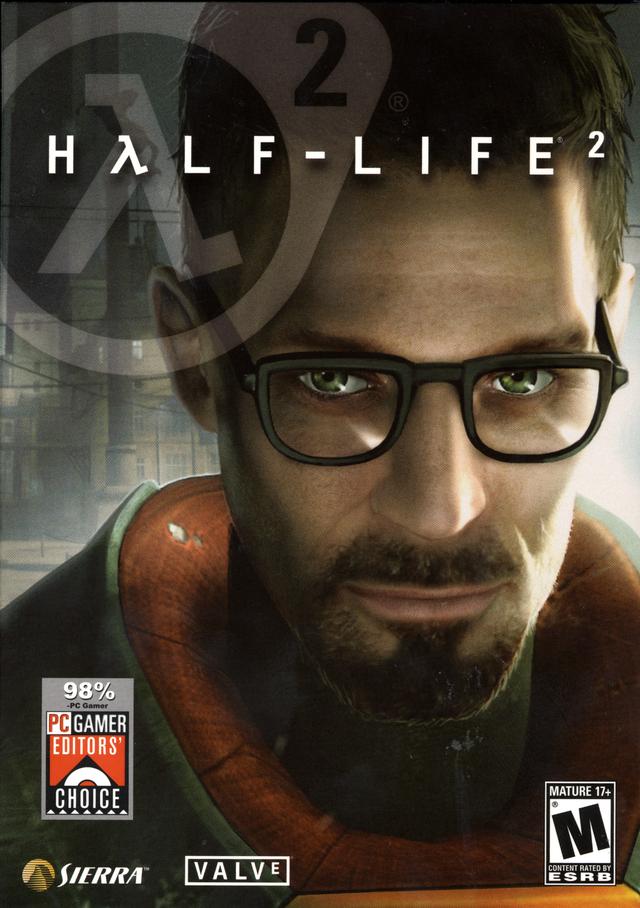
I always find Half-Life games are some of the easiest to get immersed in, the reasons for this are well documented, but that doesn't make them any less true. Having a protagonist that doesn't talk, never does anything you don't command him to, and never leaving first-person view are a good start, but filling a world with likeable characters, with actual, persistent personalities that you end up caring about goes a long way as well. This is helped a lot by great character models, animations, and facial rigs, but even Dog is likeable, and he doesn't even have a face.
Speaking of Dog, he's one of my favourite characters in any game. It's not often you can have an NPC that only appears for a couple of minutes at a time, but during those periods moves the story on so much, and all without ever speaking. He is the very definition of a 'Deus Ex Machina', but at the same time valve have created a character with real depth.
At the start of episode-1 for instance, he enables Gordon and Alyx to get onto the Citadel by putting them in a car and pitching it across a 40ft wide chasm, and manages to do it with hilarious amounts of personality. And at the end of Episode-2, he just gallops off on his own round the back of the hangar and you think "oh look at Dog, isn't he funny just running off like a little kid" only for him to burst through the ceiling a few minutes later (albeit a few seconds late), and begin to pound on the Advisors so you can escape, again making him the saviour of the day.
As well as the great characters, the varied environments you move through during your time in the game are just superb. Ravenholm is soooo fantastic, in the way it's creepy and funny at the same time, and Valve have managed to make a place where you can not only learn to use the Gravity-gun effectively, but in fact the Gravity-gun is by far and away the best way to get through it. The zombies line up and parade through the narrow corridors towards you, just asking to be dismembered by a rapidly moving circular-saw at chest height.
The first time I played through I remember picking up teh gravity gun and chucking Dogs ball about, thinking, "This is cool, but I don't know why everyone has been raving about it so much, I was expecting a bit more". Then I moved into Ravenholm and chopped and blew up some zombies and again thought "Well, this is more like it, but still, I don't know why people are calling this the best gun ever." It wasn't until the Citadel, when the gun begins to glow blue, that I never, ever wanted to put it down again. The first time I picked up a soldier and tossed him into his friends, knocking them all down a 1000ft pit I knew I was in love. And that was nothing compared to standing next to a power-beam and grabbing energy spheres to bounce into a room full of combine, watching them all disintegrate to the sound of "paong-paong-paong-paong".
There is nothing I don't like about HL2 and it's episodic sequels, and it's easy to see why it's the #1 game on Metacritic (incidentally, the Orange box is #3, and the original Half-Life is #4). It still has huge amounts of appeal and continued interest, which you can plainly see at any Valve Q&A session. Gabe Newell must be sick of hearing "When will you be releasing Episode 3?", although as I discussed earlier I don't think it will be that far off now Portal 2 is imminent. Let's hope not at least...
Speaking of Dog, he's one of my favourite characters in any game. It's not often you can have an NPC that only appears for a couple of minutes at a time, but during those periods moves the story on so much, and all without ever speaking. He is the very definition of a 'Deus Ex Machina', but at the same time valve have created a character with real depth.
At the start of episode-1 for instance, he enables Gordon and Alyx to get onto the Citadel by putting them in a car and pitching it across a 40ft wide chasm, and manages to do it with hilarious amounts of personality. And at the end of Episode-2, he just gallops off on his own round the back of the hangar and you think "oh look at Dog, isn't he funny just running off like a little kid" only for him to burst through the ceiling a few minutes later (albeit a few seconds late), and begin to pound on the Advisors so you can escape, again making him the saviour of the day.
As well as the great characters, the varied environments you move through during your time in the game are just superb. Ravenholm is soooo fantastic, in the way it's creepy and funny at the same time, and Valve have managed to make a place where you can not only learn to use the Gravity-gun effectively, but in fact the Gravity-gun is by far and away the best way to get through it. The zombies line up and parade through the narrow corridors towards you, just asking to be dismembered by a rapidly moving circular-saw at chest height.
The first time I played through I remember picking up teh gravity gun and chucking Dogs ball about, thinking, "This is cool, but I don't know why everyone has been raving about it so much, I was expecting a bit more". Then I moved into Ravenholm and chopped and blew up some zombies and again thought "Well, this is more like it, but still, I don't know why people are calling this the best gun ever." It wasn't until the Citadel, when the gun begins to glow blue, that I never, ever wanted to put it down again. The first time I picked up a soldier and tossed him into his friends, knocking them all down a 1000ft pit I knew I was in love. And that was nothing compared to standing next to a power-beam and grabbing energy spheres to bounce into a room full of combine, watching them all disintegrate to the sound of "paong-paong-paong-paong".
There is nothing I don't like about HL2 and it's episodic sequels, and it's easy to see why it's the #1 game on Metacritic (incidentally, the Orange box is #3, and the original Half-Life is #4). It still has huge amounts of appeal and continued interest, which you can plainly see at any Valve Q&A session. Gabe Newell must be sick of hearing "When will you be releasing Episode 3?", although as I discussed earlier I don't think it will be that far off now Portal 2 is imminent. Let's hope not at least...
Wednesday, January 5, 2011
A few games I've played recently: Indie Edition
As well as all the blockbusters I've been playing recently, I've also been trying my hand at a large number of indie games. Some of these were pretty rubbish, as is to be expected, but some were very good indeed. The one's I've enjoyed the most seem to be the ones other people have liked as well, which, it seems, is quite often the case.
BIT.TRIP BEAT
 I got this in the steam "Indie Pulse pack" which was full of games that are heavily based on music.
I knew BEAT was popular before I played it, but hadn't actually seen any footage of it, and screenshots don't really do it justice. As soon as I started playing I knew it was something special.
It takes the classic pong gameplay, but instead of bouncing one ball between two paddles, you control one paddle, and there are lots, and lots of excitingly acting balls to bounce back instead. The way it took a mechanic I am so familiar with, altered it, and then synchronised the whole thing with fantastic music, struck a chord with something inside me and I fell in love instantly. To illustrate how much I became enamoured with the game, I actually called my mum into the room, just because I had to show it to someone, something I've never done before (and she's never played a game in her life). It wasn't until my dad pointed out to me the background looked like something out of doom (on one particular section) that I realised there was in fact a background to look at. I had been so concentrated on the little squares flying towards my paddle that I had completely missed it. However sometimes when playing I totally zone out, and just enjoy the music, letting my instincts take over the pinging and ponging. All said and done, this title is simple in gameplay, graphics and concept, but the execution of all 3 is perfect for the game, and I can't imagine it being better.
Chime
 I picked up Chime in the Steam '12 days of Christmas' sale, and it was a great addition to my library. It's a puzzle game in the same way Bejewelled or Tetris are puzzle games, and is a cross between the two. You have geometrically shaped blocks to place on the game board, and every time you make a 3x3 block, it begins to 'fill up', this takes about 3 seconds, and if in that time you can place another block or blocks to completely cover 1 edge, it will begin to fill again, but with the new blocks added to the volume. This continues until you miss an extension, at which point the block bakes down onto the grid, raising your multiplier. It's a high score game, and the best way to get points is filling the whole grid with baked blocks. The game is set to music, and each time a block bakes down it plays an eponymous "chime" based on its shape and position, meaning each playthrough has a unique soundtrack.
This game has the same addictive quality that tetris had all those years ago, and it's obvious that parallels will be drawn when you see the shapes of the blocks you play with in Chime. It's not as stressful as a lot of games in this genre, but at times you be be angry at your brain for not seeing a way to make this block fit in that hole quickly enough.
It's a lot of fun, and it's been a while since I enjoyed a pure 'puzzle' game so much, also the music in the soundtrack is excellent (that being said, I'm a big electronic music fan already) and the graphics very tastefully done, and fit with the style perfectly.
Flotilla
 This is another game from Steam; the "Indie Air Pack" to be precise. At first I didn't play it as the screenshots seemed quite ugly, and I had to pretty games to be playing. However I later booted it up, and suddenly remembered that graphics aren't everything, and in fact it was quite pretty now that I really looked at it and my god it was fun.
The graphics, while not cutting edge by any means, are designed to be purely functional, and when you add in the classical soundtrack and leisurely pace of the game, it all creates a very pleasant and peaceful playing environment.
It is a space combat game and as the title suggests you control a flotilla of ships and fight against enemy fleets. Combat is turn based and "There is no up in space" and you should remember that. You can move your ships in any direction, and point anyway you want while doing it, which is a refreshingly honest way of playing space combat. There are only a few different types of ship, each has strengths and weaknesses and it becomes apparent fairly quickly exactly the best way to use each, which is very satisfying.
The whole thing is tied together by a very quirky but often hilarious adventure story. Each playthrough of the story is made up of semi-random encounters and lasts (depending on how long your battles take) between 20 and 45minutes, start to finish. It's worth getting the game for the limited story alone, just to see how much fun playing an entire story-arch in a lunch break can be, and to meet some of the personalities inhabiting the galaxy with you. These range from mercenary-cats and casino owning owls, to deer in charge of the interplanetary police.
There are online leader boards, and while getting a high score will often be dependant on what encounters you get in the story, it is fun to see how you match up with others playing the game, something which kept me coming back.
BIT.TRIP BEAT

I knew BEAT was popular before I played it, but hadn't actually seen any footage of it, and screenshots don't really do it justice. As soon as I started playing I knew it was something special.
It takes the classic pong gameplay, but instead of bouncing one ball between two paddles, you control one paddle, and there are lots, and lots of excitingly acting balls to bounce back instead. The way it took a mechanic I am so familiar with, altered it, and then synchronised the whole thing with fantastic music, struck a chord with something inside me and I fell in love instantly. To illustrate how much I became enamoured with the game, I actually called my mum into the room, just because I had to show it to someone, something I've never done before (and she's never played a game in her life). It wasn't until my dad pointed out to me the background looked like something out of doom (on one particular section) that I realised there was in fact a background to look at. I had been so concentrated on the little squares flying towards my paddle that I had completely missed it. However sometimes when playing I totally zone out, and just enjoy the music, letting my instincts take over the pinging and ponging. All said and done, this title is simple in gameplay, graphics and concept, but the execution of all 3 is perfect for the game, and I can't imagine it being better.
Chime
 I picked up Chime in the Steam '12 days of Christmas' sale, and it was a great addition to my library. It's a puzzle game in the same way Bejewelled or Tetris are puzzle games, and is a cross between the two. You have geometrically shaped blocks to place on the game board, and every time you make a 3x3 block, it begins to 'fill up', this takes about 3 seconds, and if in that time you can place another block or blocks to completely cover 1 edge, it will begin to fill again, but with the new blocks added to the volume. This continues until you miss an extension, at which point the block bakes down onto the grid, raising your multiplier. It's a high score game, and the best way to get points is filling the whole grid with baked blocks. The game is set to music, and each time a block bakes down it plays an eponymous "chime" based on its shape and position, meaning each playthrough has a unique soundtrack.
This game has the same addictive quality that tetris had all those years ago, and it's obvious that parallels will be drawn when you see the shapes of the blocks you play with in Chime. It's not as stressful as a lot of games in this genre, but at times you be be angry at your brain for not seeing a way to make this block fit in that hole quickly enough.
It's a lot of fun, and it's been a while since I enjoyed a pure 'puzzle' game so much, also the music in the soundtrack is excellent (that being said, I'm a big electronic music fan already) and the graphics very tastefully done, and fit with the style perfectly.
Flotilla
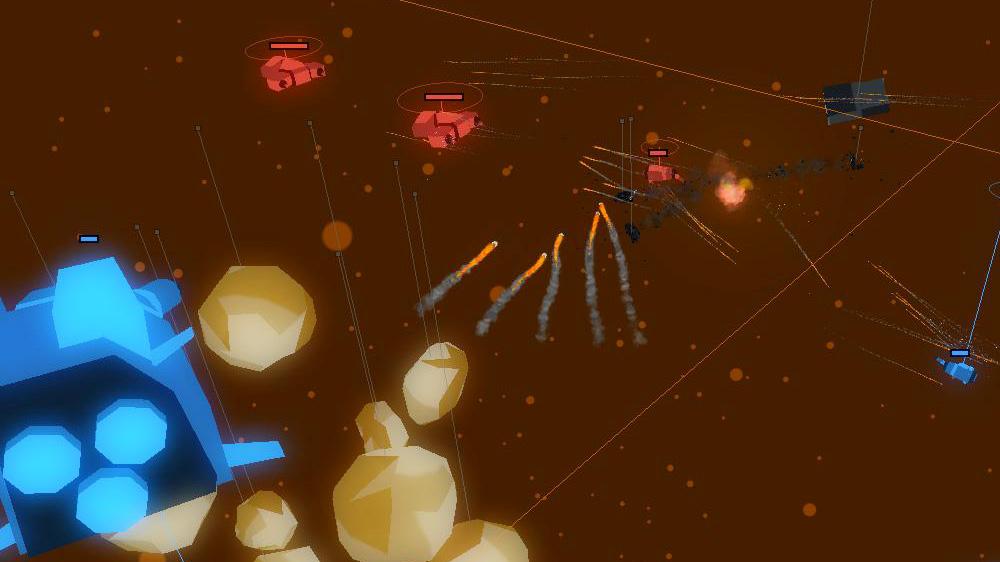
The graphics, while not cutting edge by any means, are designed to be purely functional, and when you add in the classical soundtrack and leisurely pace of the game, it all creates a very pleasant and peaceful playing environment.
It is a space combat game and as the title suggests you control a flotilla of ships and fight against enemy fleets. Combat is turn based and "There is no up in space" and you should remember that. You can move your ships in any direction, and point anyway you want while doing it, which is a refreshingly honest way of playing space combat. There are only a few different types of ship, each has strengths and weaknesses and it becomes apparent fairly quickly exactly the best way to use each, which is very satisfying.
The whole thing is tied together by a very quirky but often hilarious adventure story. Each playthrough of the story is made up of semi-random encounters and lasts (depending on how long your battles take) between 20 and 45minutes, start to finish. It's worth getting the game for the limited story alone, just to see how much fun playing an entire story-arch in a lunch break can be, and to meet some of the personalities inhabiting the galaxy with you. These range from mercenary-cats and casino owning owls, to deer in charge of the interplanetary police.
There are online leader boards, and while getting a high score will often be dependant on what encounters you get in the story, it is fun to see how you match up with others playing the game, something which kept me coming back.
Subscribe to:
Posts (Atom)


